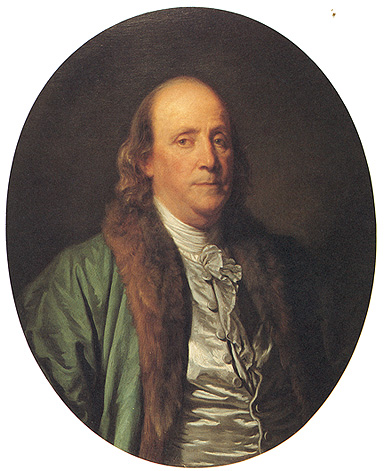
Benjamin Franklin, like many of the Founding Fathers of our country, was a very gifted and talented man of wide-ranging interests. In his Autobiography, he tells how he decided to engage in a systematic effort to develop moral perfection in his life. Franklin did not attend church very often (although he did go five Sundays in a row once!), partly because of what he considered the low quality of the preaching. He was a Deist, as many were in his time, and he considered himself a religious man. As part of his effort at "religion", he developed his plan for moral perfection.
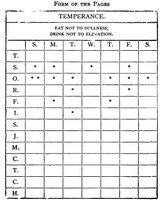
The system he developed was detailed and thorough. He created a chart of 13 positive moral qualities which he would focus on. His chart was divided into days of the week on the top and moral qualities on the left. He carried this chart with him in a small book and would focus on a different quality each week, noting each day when he failed to live up to that quality. At one point he says "As I knew, or thought I knew, what was right and wrong, I did not see why I might not always do the one and avoid the other." He soon found out that his goal was more difficult that he realized. As he focused on one fault, other faults would take advantage of him.
Over time, he did improve in the areas he worked on, but, he says, "I was surprised to find myself so much fuller of faults than I had imagined." Eventually, he came to the conclusion that he would have to live with some faults, but his reason is not what you would think. He realized that a man of perfect character would be either envied or hated or both. So he decided to keep a few faults in order to keep his friends!
I give Franklin great credit for being honest about himself and for making the noble effort to systematically improve his character. How many today put so much attention and effort into such a work?
Although people today will admit they aren’t perfect, most people believe that mankind as a whole is basically good. We are not the "sinners" that the mean, grumpy preachers tell us we are. In fact, one famous pastor believes it is wrong to tell someone he is a sinner; he believes our problem is low self-esteem, not "sin".
I find it amazing that people still cling to the outdated belief that people are basically good. Not only does the Bible very clearly teach the opposite (Romans 3:9-18), but experience shows us we are all morally imperfect (sinners) in our actions, attitudes, and nature. Sin is much more than selfishness. Sin is a fundamental violation of and rebellion to God’s moral requirements. Law libraries are filled with shelves of books to regulate human conduct. Our country is overflowing with judges, lawyers, prosecutors, and overcrowded jails. Professional counselors enjoy a steady business. Bookstores are filled with self-help and personal improvement books. And many suffer in silence behind closed doors, not seeking help, yet not happy either.
Strange, isn’t it, how we try to convince ourselves that we are good people, yet we sing songs at Christmas celebrating the birth of a Savior. Many Christmas songs that we sing so enthusiastically, and often without careful reflection on what they are saying, focus on powerful sin as the reason "the Word was made flesh" (John 1:14). For example, "Joy To The World" in stanza three mentions "No more let sins and sorrows grow, . . . He comes to make His blessings flow, Far as the curse is found." In "Hark, The Herald Angels Sing", stanza one says "God and sinners reconciled". In the English carol "God Rest You Merry, Gentlemen", stanza one says "Remember Christ our Savior was born on Christmas Day; To save us all from Satan’s power, When we were gone astray."
The Bible portrays sin as a powerful enemy, a force within us that we cannot escape by our own power. Yes, people like Benjamin Franklin can improve themselves through hard work and determined willpower. Yet very often such "success" creates modern-day Pharisees who believe they are good enough for God.
Christmas is the celebration of the birth of the Savior, Jesus of Nazareth, the Christ. People who are not that bad don’t need a Savior. Our problem is not medical, psychological, educational, financial, or environmental. Our root problem is spiritual, a broken relationship with the Lord God. Any solution other than Christ only masks the real need and will only disappoint eventually.

The system he developed was detailed and thorough. He created a chart of 13 positive moral qualities which he would focus on. His chart was divided into days of the week on the top and moral qualities on the left. He carried this chart with him in a small book and would focus on a different quality each week, noting each day when he failed to live up to that quality. At one point he says "As I knew, or thought I knew, what was right and wrong, I did not see why I might not always do the one and avoid the other." He soon found out that his goal was more difficult that he realized. As he focused on one fault, other faults would take advantage of him.
Over time, he did improve in the areas he worked on, but, he says, "I was surprised to find myself so much fuller of faults than I had imagined." Eventually, he came to the conclusion that he would have to live with some faults, but his reason is not what you would think. He realized that a man of perfect character would be either envied or hated or both. So he decided to keep a few faults in order to keep his friends!
I give Franklin great credit for being honest about himself and for making the noble effort to systematically improve his character. How many today put so much attention and effort into such a work?
Although people today will admit they aren’t perfect, most people believe that mankind as a whole is basically good. We are not the "sinners" that the mean, grumpy preachers tell us we are. In fact, one famous pastor believes it is wrong to tell someone he is a sinner; he believes our problem is low self-esteem, not "sin".
I find it amazing that people still cling to the outdated belief that people are basically good. Not only does the Bible very clearly teach the opposite (Romans 3:9-18), but experience shows us we are all morally imperfect (sinners) in our actions, attitudes, and nature. Sin is much more than selfishness. Sin is a fundamental violation of and rebellion to God’s moral requirements. Law libraries are filled with shelves of books to regulate human conduct. Our country is overflowing with judges, lawyers, prosecutors, and overcrowded jails. Professional counselors enjoy a steady business. Bookstores are filled with self-help and personal improvement books. And many suffer in silence behind closed doors, not seeking help, yet not happy either.
Strange, isn’t it, how we try to convince ourselves that we are good people, yet we sing songs at Christmas celebrating the birth of a Savior. Many Christmas songs that we sing so enthusiastically, and often without careful reflection on what they are saying, focus on powerful sin as the reason "the Word was made flesh" (John 1:14). For example, "Joy To The World" in stanza three mentions "No more let sins and sorrows grow, . . . He comes to make His blessings flow, Far as the curse is found." In "Hark, The Herald Angels Sing", stanza one says "God and sinners reconciled". In the English carol "God Rest You Merry, Gentlemen", stanza one says "Remember Christ our Savior was born on Christmas Day; To save us all from Satan’s power, When we were gone astray."
The Bible portrays sin as a powerful enemy, a force within us that we cannot escape by our own power. Yes, people like Benjamin Franklin can improve themselves through hard work and determined willpower. Yet very often such "success" creates modern-day Pharisees who believe they are good enough for God.
Christmas is the celebration of the birth of the Savior, Jesus of Nazareth, the Christ. People who are not that bad don’t need a Savior. Our problem is not medical, psychological, educational, financial, or environmental. Our root problem is spiritual, a broken relationship with the Lord God. Any solution other than Christ only masks the real need and will only disappoint eventually.
